78° north
Svalbard
Up here the year has one night and one day. You sail in the day.
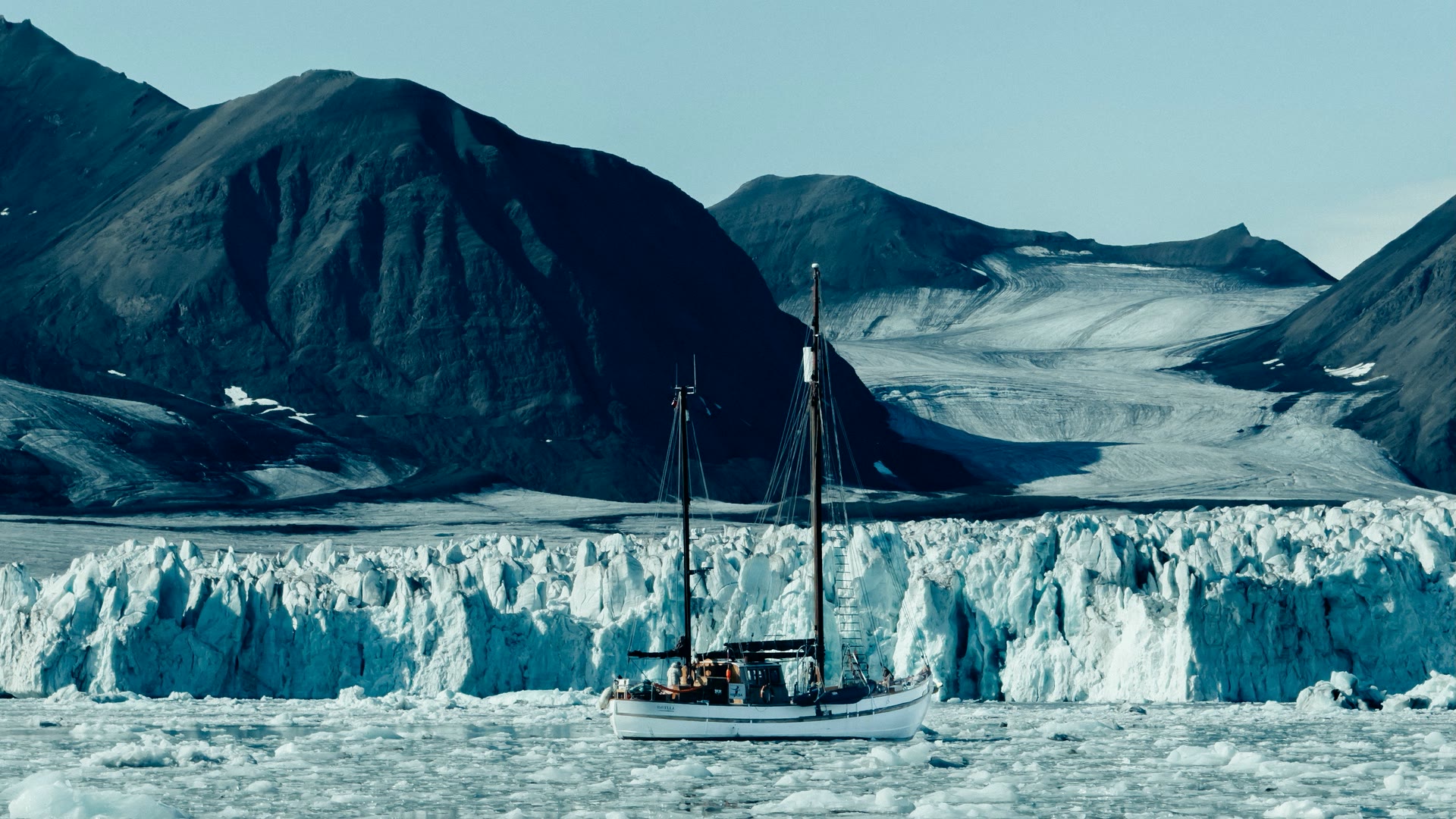
A yacht below a glacier front, SvalbardA summer voyage, May to August. Twelve guests or fewer.
A yacht below a glacier front, Svalbard- Season
- May to August
- Length
- Around ten days
- Party
- Twelve guests or fewer, or the ship to yourselves
- Held in the arrangement
- The ship and her crew, a guide who keeps the bear watch ashore, every meal aboard, and the flights to Longyearbyen and back
The place
Halfway from Norway to the Pole, and the light does as it likes.
Svalbard is a scatter of islands at seventy-eight degrees north: bare rock, glacier and frozen sea, one small town, a few thousand people. More than half the land lies under ice.
What changes here is the light. For months the sun does not rise. Then for months it does not set. Everything else follows from that: when the sea opens, when the birds come, and when a small ship can go north.
The year, by its light
You sail in summer, in the long day. The dark, the blue and the return come first here because they are why the place looks as it does.

The blueFebruary
Then noon turns blue, and stays blue for hours.
By February the sun is close under the horizon. At midday the snow, the sea ice and the sky all take the same colour, and a band of rose stands in the south. It is the quietest light of the year.


The returnMarch and April
In early March the sun comes back.
First a seam of orange over the fjord at noon. A week later it clears the mountains, and the town stops to watch. After that each day is longer than the last by twenty minutes and more, and the white valleys belong to the dog teams.

By late April the sun has stopped setting. It will not set again until the end of August.

North, until the sea turns white.
You sail from Longyearbyen up the west coast. Glacier fronts that crack like rifle shots. Cliffs loud with kittiwakes. Walrus hauled out on a shingle spit, entirely unbothered by you.
Each day the water carries more ice, until one morning there is nothing ahead but white, all the way to the Pole. That is the edge. The ship stops, and everyone comes on deck without being asked.


And the bear, if it chooses.
Somewhere out there, there may be one. Your guide will find it through the glasses long before you do, and the ship will keep her distance. Some voyages see several. Some see none.
Go north to the edge of the iceAround ten days, north and back. The route is drawn with you, then redrawn by the ice, which has the last word up here.
Plan your journey Turn the yearThe ship

No hotel goes where you are going. A small ship does.
She is chosen with you: a small ship that knows these waters, a dozen berths at most, a warm saloon, and a deck you will be called out to at odd hours.
Small is the point. She can stop the engine and lie off a glacier front, put a boat ashore on a beach no larger ship would trouble with, and wait a whole afternoon because something white is moving on the ice.
Looked after, where the bear has right of way.
Nobody walks alone on Svalbard. A guide goes ashore first, every time, and keeps watch while you look at everything else. Back aboard there is coffee before your boots are off, and dinner at whatever hour the light has made you forget.

Field notesThe figures, for those who like them.
- Daylight there today
- Daylight in the middle of June
- The sun does not set
- about 20 April to 23 August
- The sun first seen from the town
- 8 March
- Longyearbyen
- 78°13′N 015°38′E
- From there to the Pole
- about 1,300 km

Your invitation
Which light?
May and June for ice still in the fjords and a sun that never sets. July and August for open water, and as far north as the ice allows.
Eight short questions, about two minutes. Then a letter in your own words.