Bhutan
The last of it is on foot.
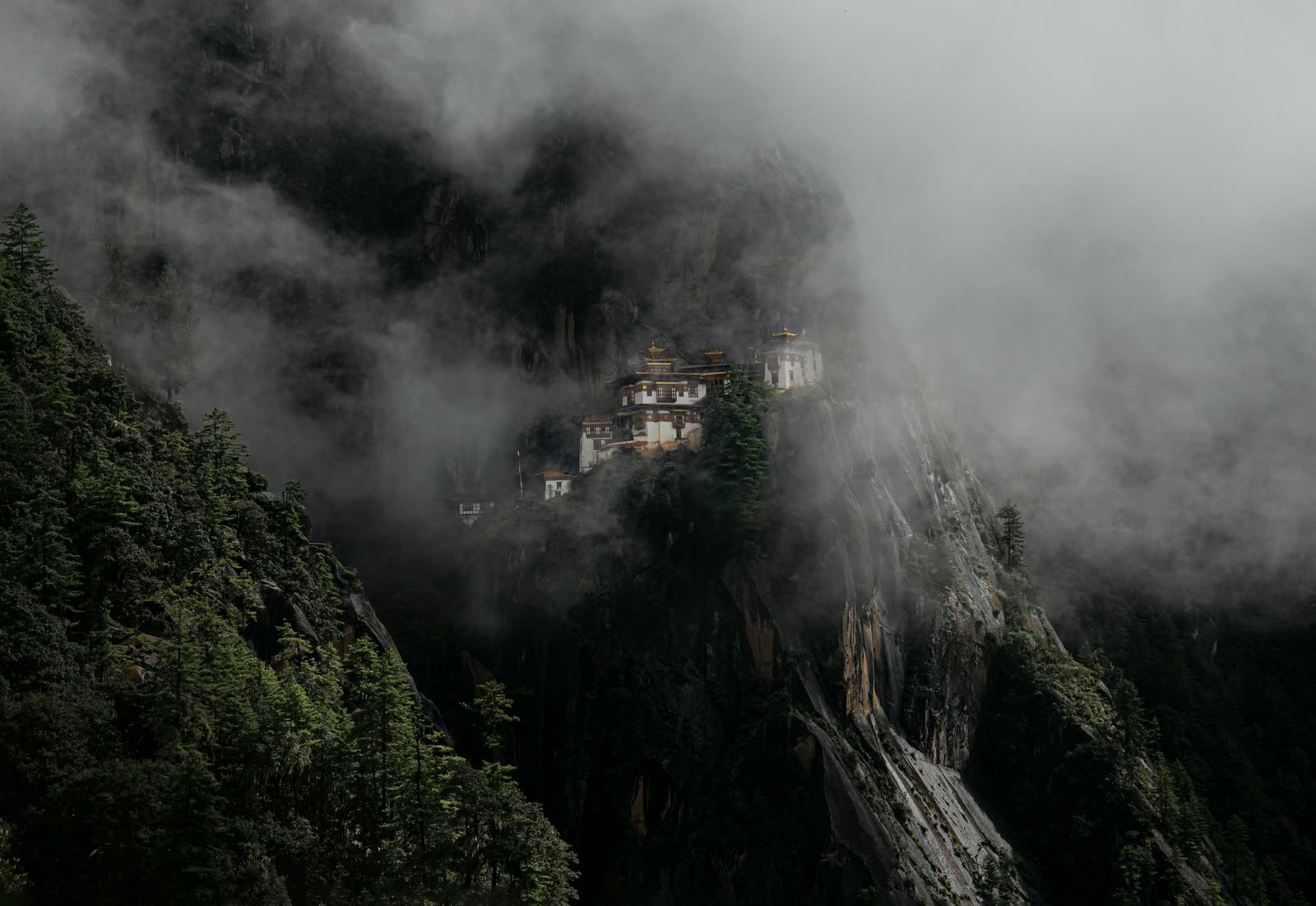
Steep valleys, whitewashed walls, and a monastery you can only walk to. By private arrangement.
Paro Taktsang, the Tiger's Nest- Season
- March to May, and September to November
- Length
- Around nine days
- Party
- Two to six, with your own guide
- Held in the arrangement
- Three valleys and the roads between them, your guide and driver throughout, every night's stay, and an unhurried day for the climb
The place
A kingdom of steep valleys, where the grandest thing in each was built to pray in.
The valleys lie between two and three thousand metres, and the road from one to the next goes over a pass hung with flags. In each stands a dzong: whitewashed walls as thick as a room, carved timber above, a courtyard within. Part fortress, part monastery, and still lived in.
Nothing here is hurried. You take your shoes off often. You learn to walk round things the right way. And the place you came for cannot be driven to.

The days

First days
It begins with a doorway.
You step over a timber sill worn into a curve, out of the sun and into the thickness of the wall. For a moment it is dark and smells of old wood and butter lamps. Then the courtyard opens in front of you, white and red and gold, and far quieter than its size.

Between the valleys
The road goes up into the cloud.
Every pass has its flags, strung from tree to tree and left to the weather. You stop at the top, get out into the cold, and listen to them. On a clear day there are white peaks along the whole northern sky. On the other days there is this, and it is no worse.
Prayer flags on Chele LaInside the walls
You are a guest in somebody's working day.
The dzongs are not kept for you. Robes cross the flagstones on their own errands, a door closes, a bell is struck somewhere you will not be going. You stand at the edge of it, lower your voice without being asked, and stay longer than you meant.

If this is the one, tell us when

Across the gorge
And then it is level with you.
For two hours it has been a white mark overhead, there and gone in the cloud. Now the path comes out on a ledge and the whole of it is across from you: roofs, windows, a cliff that should not hold a building at all. Nobody says much. You sit down.

That is the shape of it: about nine days, three valleys, and the climb kept for the end, when your legs and your lungs are ready for it. The plan is drawn with you.
Plan your journeyThe stay
Stone, timber, a stove, and the valley in the window.
You stay in small lodges built the way the valley builds: thick walls, painted beams, a handful of rooms. They are chosen with you, for their quiet and for what the window looks at.
What you remember is the evening after the climb. Boots off, legs heavy, tea in both hands, and the cliff you sat across from that morning somewhere up in the dark.

Walked up by someone who has done it a hundred times.
You travel with a Bhutanese guide from the first day to the last. Yours knows the hour a courtyard empties, which way round to walk, and when to say nothing at all. On the last morning they set a pace that feels too slow, and turns out to be exactly right.

Field notesThe figures, for those who like them.
- Daylight there today
- Daylight in the middle of April
- Daylight in the middle of October
- Paro Taktsang
- 27°30′N 089°22′E
- The monastery
- About 3,100 m
- The valley floor at Paro
- About 2,200 m

Your invitation
Come on foot.
March to May for the valleys in flower. September to November for clear air and long views.
Eight short questions, about two minutes. Then a letter in your own words.